.svg)

New free service will help tenants through eviction process
The government’s Housing Loss Prevention Advice Service will provide free legal advice to anyone facing eviction – and landlords are worried it could cost them.
In May we asked 500 UK landlords and 500 letting agents how ready they were for Making Tax Digital. What came back says less about readiness than it does about you: landlords already trust their agent to handle this, and most have no idea it’s on offer. Here’s how that gap opened, and what April 2027 does to it.
82% of the letting agents we surveyed said they were worried about making mistakes or facing penalties under MTD. Among landlords it was 59%.
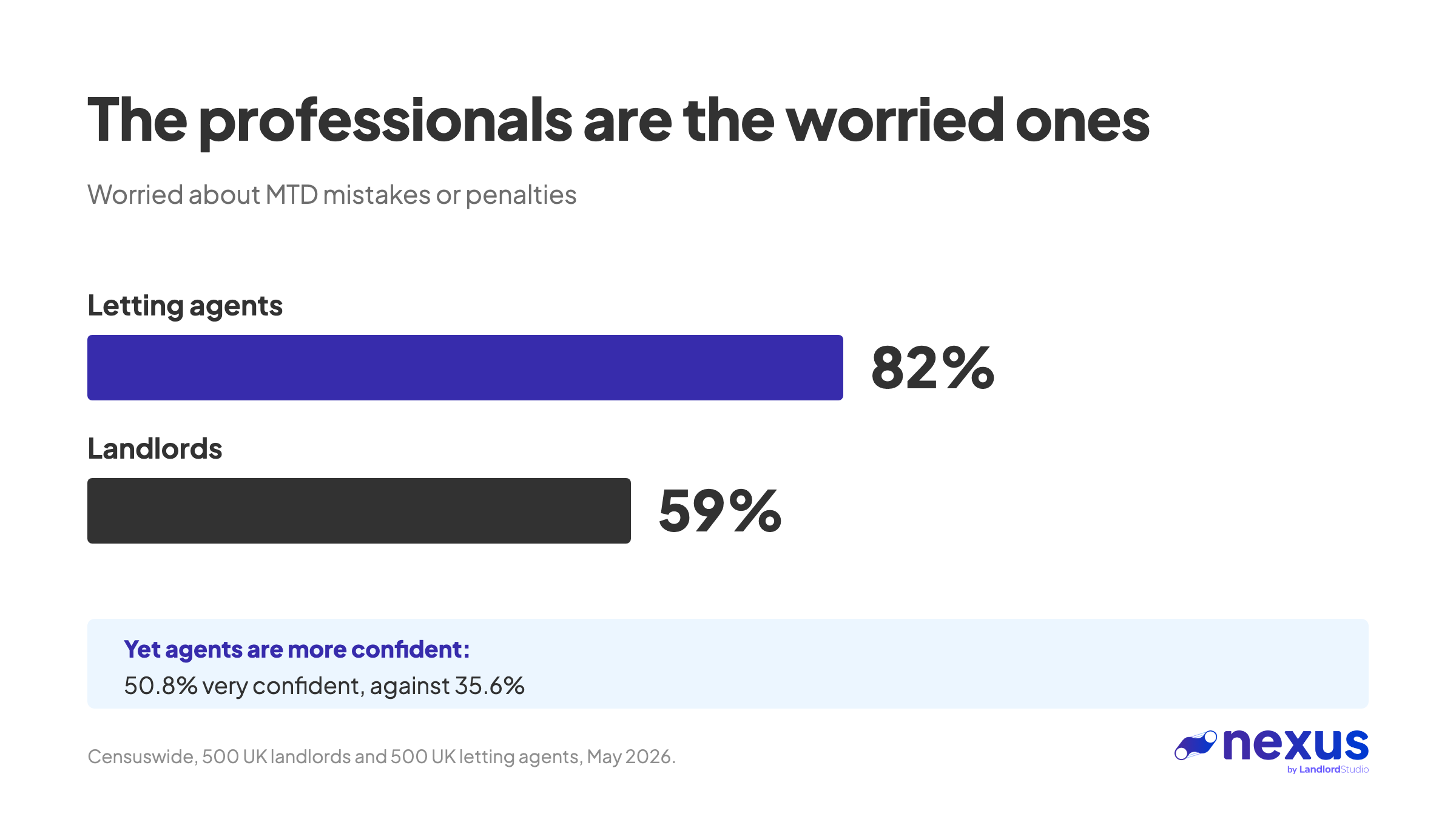
What makes that strange is that the confidence numbers run the other way. Half the agents, 50.8%, called themselves very confident they understand what MTD requires. Only 35.6% of landlords said the same.
So agents are more confident and more worried at the same time. If you’ve ever taken a client accounts team through a deadline you’ll recognise that feeling. You know the process well enough to know where it usually goes wrong.
Only landlords over the £50,000 threshold have filed a quarterly submission so far. For everyone else that confidence is real, it just hasn’t been tested on anything yet. Yours has.
“Landlords thought they were ready. But when you dug into the detail, they weren’t actually prepared, and they didn’t really know what ‘ready’ meant.”
Logan Ransley, Managing Director, Nexus by Landlord Studio
There’s something real behind the worry. Only a third of landlords, 33.6%, use software for their tax and record-keeping. Another 39.2% are still working from spreadsheets or paper.
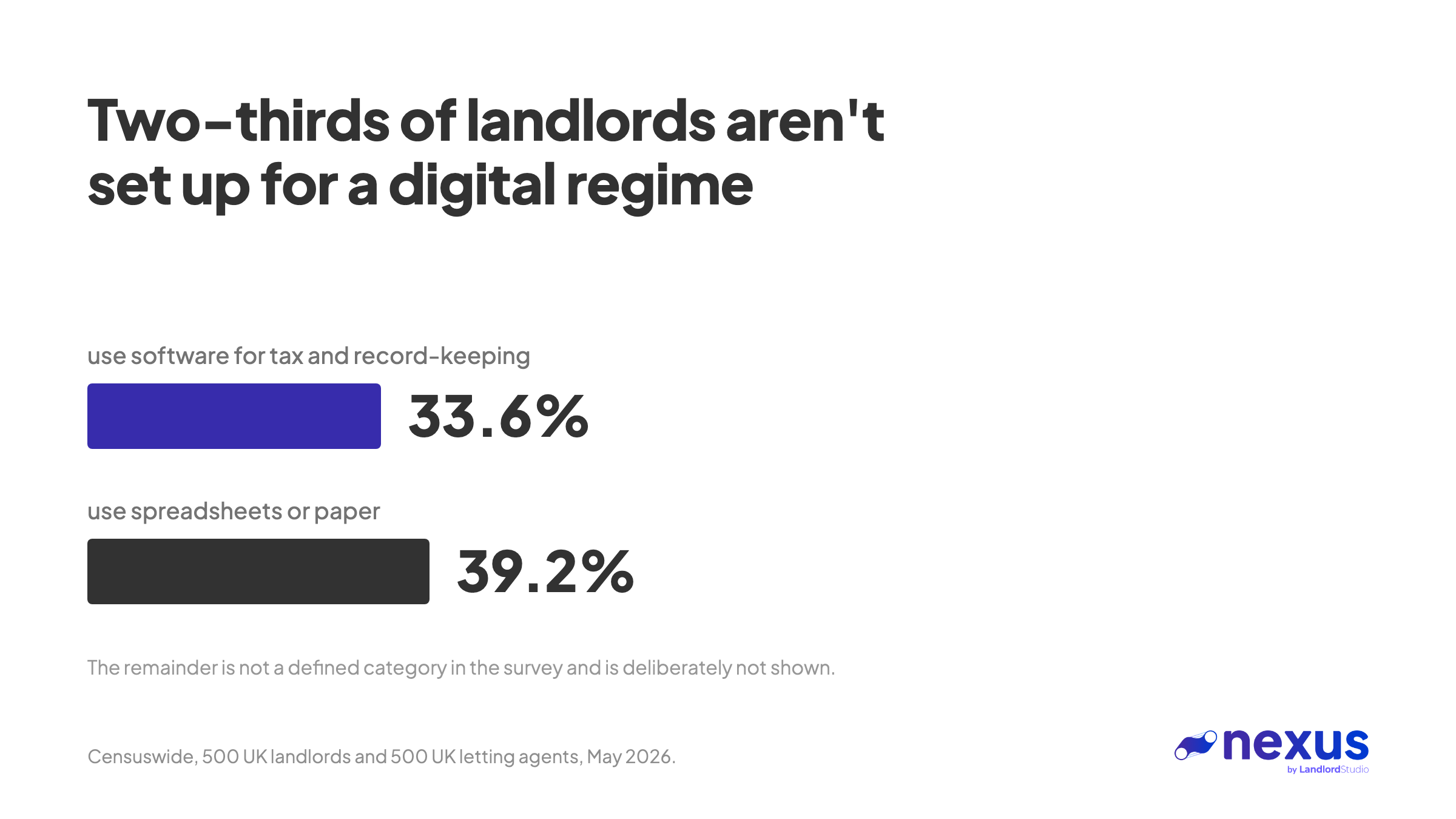
MTD assumes digital records from the start, so two-thirds of the landlords whose properties you manage aren’t set up for the way it works.
Ask landlords what they find hardest and you get the same three answers: keeping accurate records (38%), the risk of errors and penalties (36%), and the time it takes (34%). All three are worse on a spreadsheet.
The agents we spoke to aren’t being pessimistic. They can see a client base that hasn’t moved yet, and they know who gets the first phone call.
“They are a demanding bunch, and they certainly want to get their value out of their agents for their management fees. It’s likely to cause a strain on property managers, perhaps even client accountants.”
Josh Findlater, Head of Sales, Reapit
Two things make this harder over the next eighteen months.
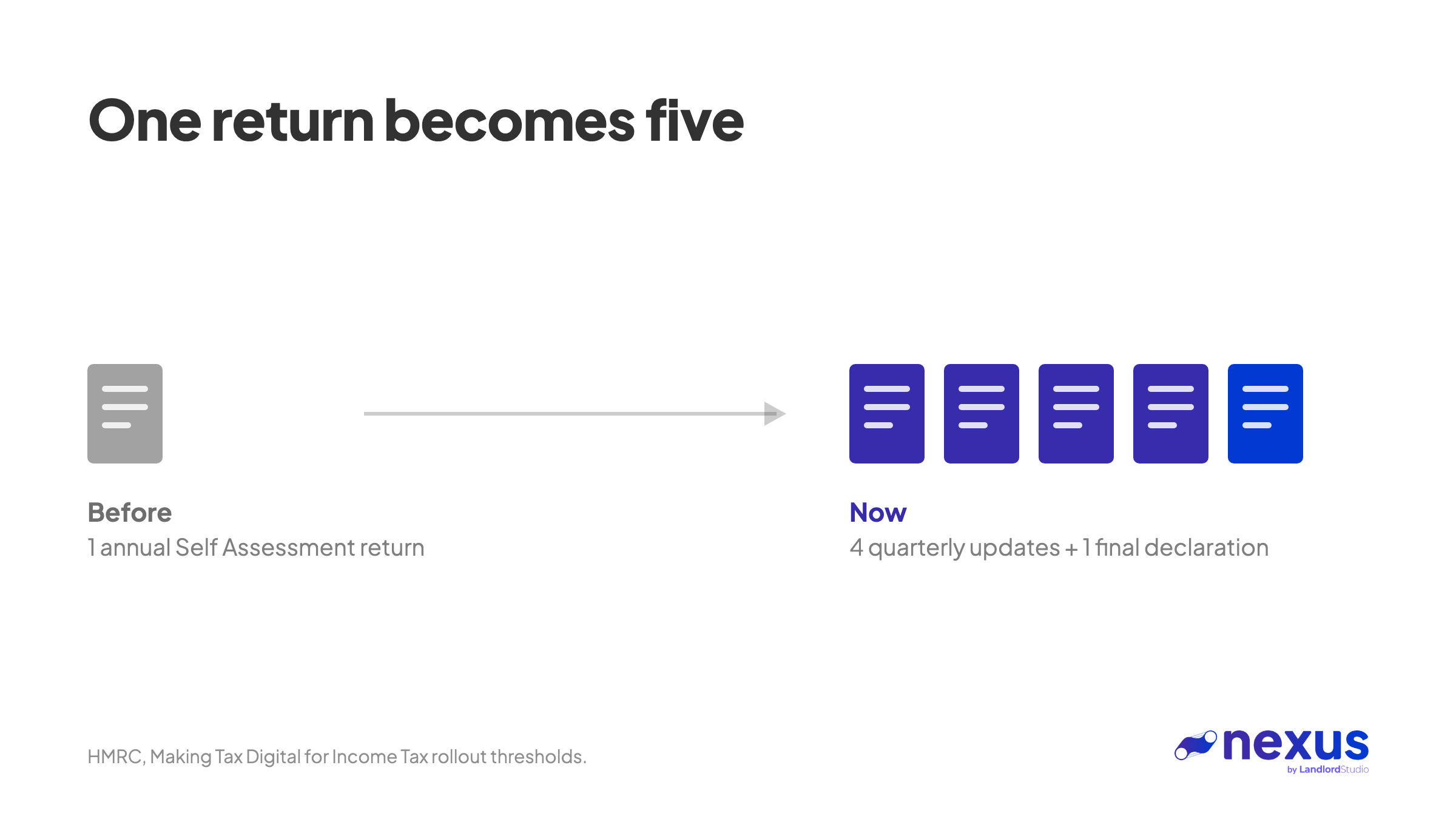
One is frequency. A single annual return becomes five submissions: four quarterly updates and a final declaration. Leaving it to a scramble in January worked when it happened once a year. It doesn’t work four times.
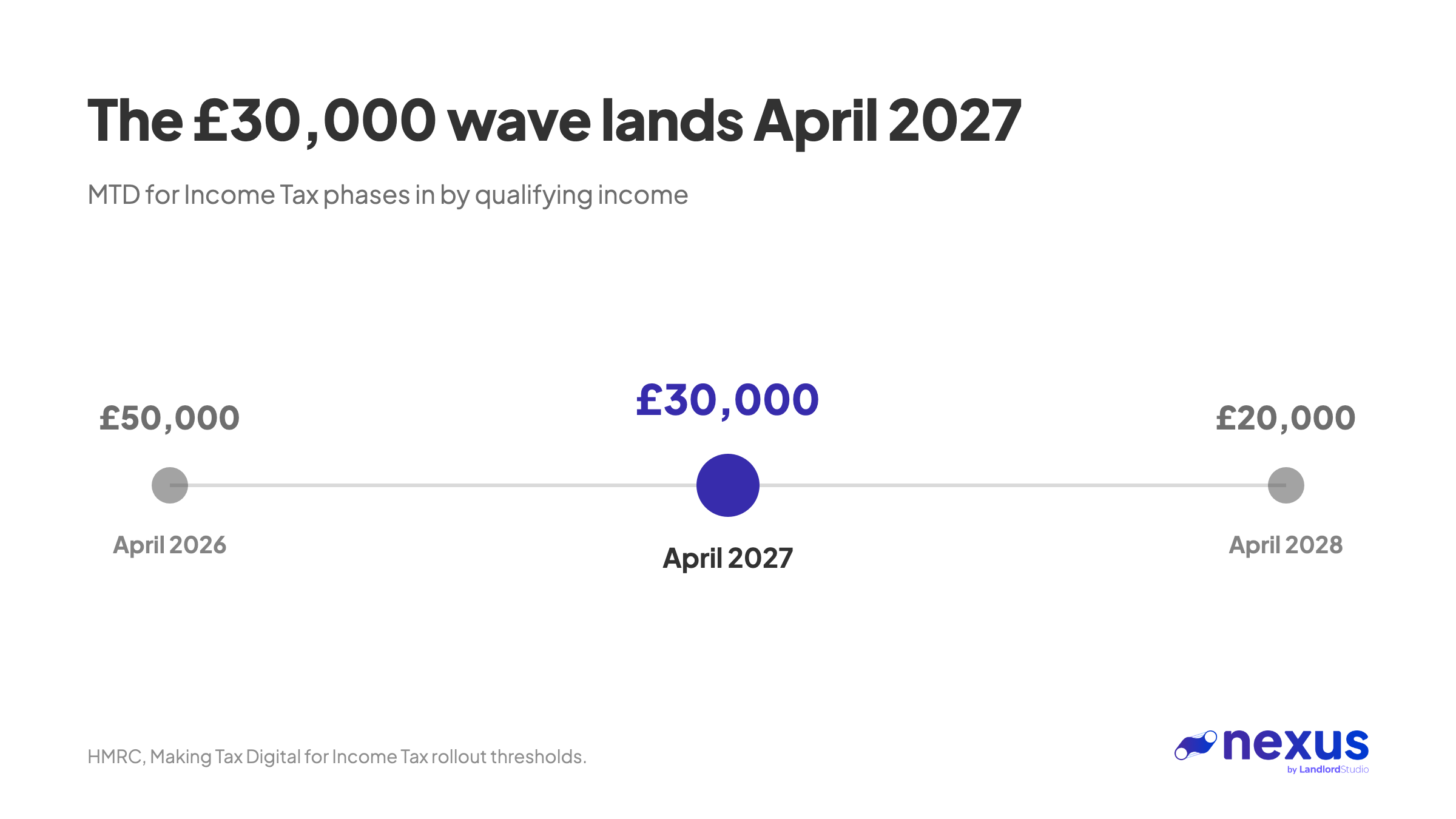
The other is volume. The thresholds drop in stages: £50,000 from April 2026, £30,000 from April 2027, £20,000 from April 2028. April 2027 is the big one by some distance, and that’s the wave that reaches most managed portfolios.
The good news, and I do think it’s good news, is that MTD isn’t asking for information you don’t already hold. The rent, the management fee, the contractor payment, the repair. It’s all in your client accounting system and it’s already digital.
The problem is format. A rental statement is a record of what happened, and a PDF can’t be linked to a submission. So the figures get typed out again by the landlord or their accountant, four times a year, for every property.
“MTD is not creating a need for new data. It’s just requiring the data in a different format.”
Logan Ransley, Managing Director, Nexus by Landlord Studio
The first deadline has already been and gone, so we’re not guessing about this.
Most of what went wrong wasn’t the part anyone had worried about. The submission itself is easy once records sit in software that’s connected to HMRC. It’s close to a button press.
Setup was the problem. Registering with HMRC, registering as a property business, getting an accountant authorised, all of it took weeks rather than an afternoon. Landlords who left it until the last week ended up on the phone to HMRC, and then on the phone to their agent.
“We saw landlords scrambling, trying to get hold of HMRC. Their accounts weren’t set up on the gateway and they didn’t know why.”
Logan Ransley, Managing Director, Nexus by Landlord Studio
One thing worth correcting while I’m here, because plenty of people still believe it: landlords can’t submit to HMRC by uploading a spreadsheet any more. The records have to sit in MTD-compatible software that’s digitally linked to HMRC. A CSV export from your system still helps, but it won’t finish the job.
Whatever route your landlords take, they need to start the HMRC side weeks earlier than they think.
"There was certainly intrigue in the early days.
Whereas now, there's urgency."
Josh Findlater, Head of Sales, Reapit
One finding surprised me more than the confidence gap did.
90% of landlords say letting agents are well-equipped to help them with MTD. 88% say agents make it easier. And half of them say they had no idea that support existed. Among agents, 71% say the same.
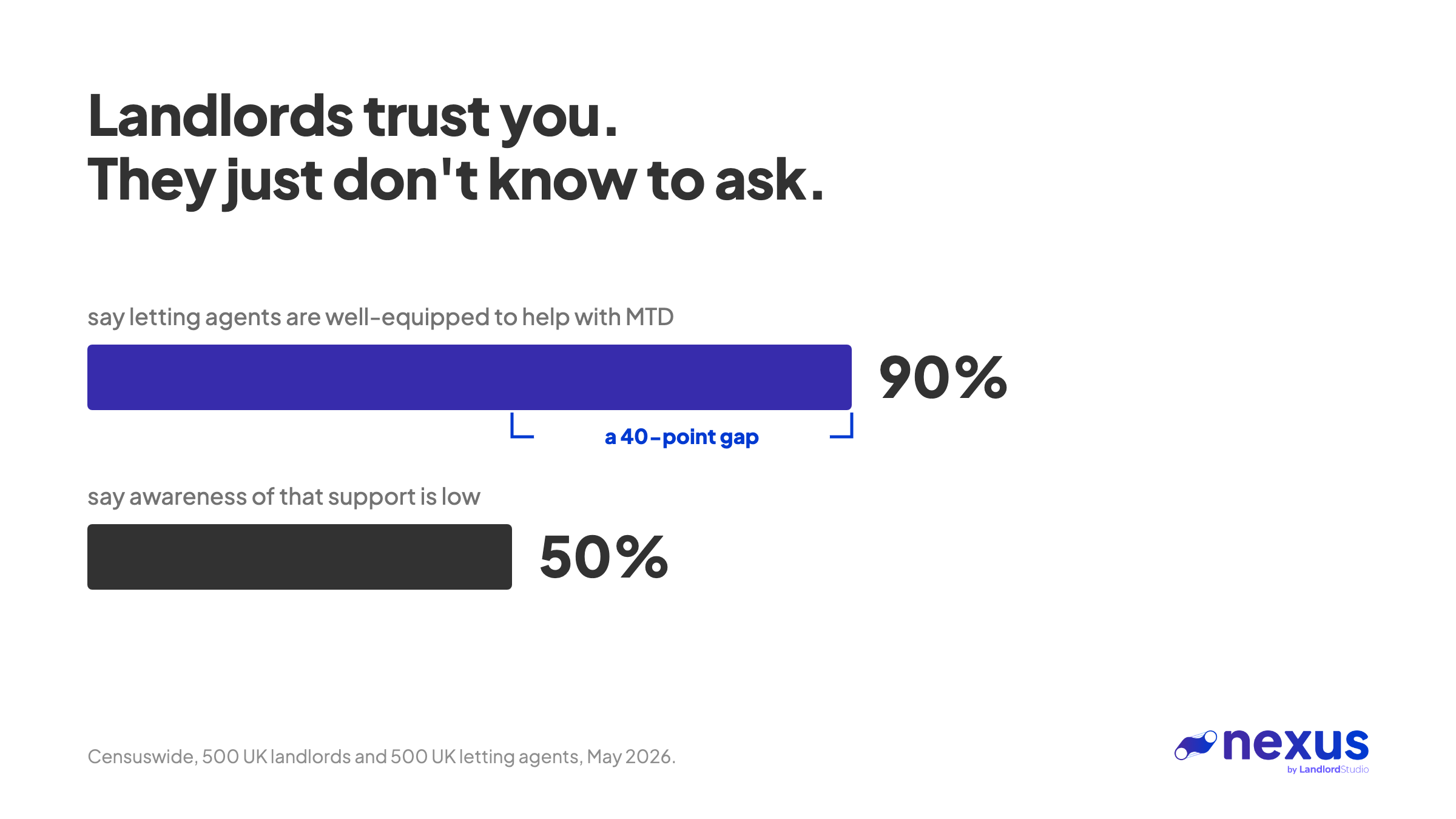
So you already have the trust. What’s missing is anyone telling them.
98% say they’re likely to invest in tax and compliance software over the next year or two, so that money is going to be spent either way. There’s also a cost to sitting still. Landlords are losing around 13 hours a month to tax and financial admin, time they put a value of more than £3,300 a year on, and 22% have thought about leaving the rental market altogether because of the admin. Those are your clients and your managed stock.
“It’s almost a reverse education, where the landlords are starting to come to their agent saying: what do you know about this, how can you help me?”
Logan Ransley, Managing Director, Nexus by Landlord Studio
When a landlord asks what you’re doing about MTD, there are two honest answers.
You can say: here’s your statement, your accountant can take it from there. That’s defensible and it costs you nothing today. It also comes round four times a year now, and it lands a little worse each time.
Or you can say: here’s your data, and here’s the route that turns it into a submission. Same information, same effort from your team, a completely different conversation.
That isn’t really a workload decision. It’s whether your agency is where the problem starts or where it gets sorted.
Most of the conversation about MTD treats it as a cost. More admin, more questions, more time out of a team that hasn’t got it. That is only true if you handle it as a compliance chore.
Landlords have to use MTD-compatible software. It isn’t optional, and 98% of them expect to spend on tax and compliance software within the next year or two. The only open question is whether that decision runs through your agency or around it.
The agencies furthest ahead are treating MTD the way they already treat referencing, insurance and mortgage introductions: something the client needs, arranged by the agent, that deepens the relationship and adds to the agency’s offer.
“The more well-established agencies are taking this seriously. They’re viewing MTD as both a service they can provide for their landlords and, more importantly, one they can charge for.”
Josh Findlater, Head of Sales, Reapit
None of this has to be settled this week, but a few things are worth putting in motion.
We built Nexus with PayProp because the data was already sitting in the right place in the wrong format.
Nexus connects to PayProp, and the records you already produce, rent, management fees, repairs, contractor payments, land in the landlord’s own account as categorised digital records for them to review and submit. It’s recognised by HMRC as Making Tax Digital software, so the submission goes from Nexus to HMRC directly. Nobody re-keys a statement, you don’t produce a new export, and nothing changes for your client accounts team. You invite the landlord and they take it from there.
It’s live with more than 120 agencies, from independents to LRG, and we built it alongside more than 40 accounting firms so it works the way accountants do.
The full research is in our MTD readiness report. If you’d like to see the PayProp integration working, book a walkthrough. Partner setup takes about fifteen minutes.
Source: Censuswide surveyed 500 UK landlords and 500 UK letting agents between 22 and 29 May 2026 on behalf of Landlord Studio.
Sign up for the month's most important UK private rented sector headlines, curated by us.





.svg)